

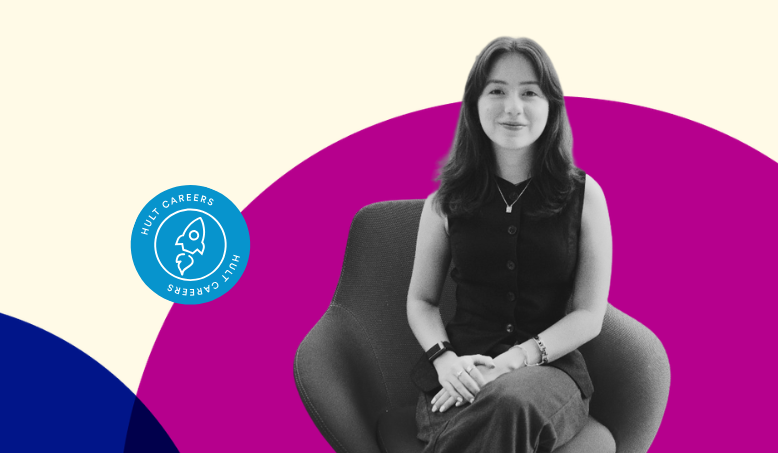

When Hult Boston BBA student Annel Camacho started looking for a summer internship, she had one clear goal: find something in real estate. She’d spent her gap year working in housing before college, and she knew that world suited her.
What she didn’t expect was to land a role on the Global Real Estate team at BCG—one of the most competitive consulting firms in the world, and spend 14 weeks automating processes her team had been doing by hand for years.
We caught up with Annel to find out how she got there, what she built, and what she’d tell other Hult students who are just starting their internship search.
Hult: How did you find the role and decide to apply?
Annel: I was mainly looking for something in real estate. A friend had interned at BCG the summer before, so I went to see if they had anything relevant. I came across this opening with their global real estate team here in Boston. It was commercial real estate, more focused on office spaces, which was different from my gap year experience, but it still fell under that umbrella. And the role had a data analytics component, which lined up with my major. It felt like a good fit, so I applied.
H: Walk us through the interview process.
A: It was a few rounds. The first was a 30-minute call with Maria from HR. She went through my work experience and the projects I’d done at Hult. Then she passed resumes to my now-manager, Bethany, who interviewed around 20 people at that stage. After that, a colleague named Sarah interviewed just three of us in the final round. It was more technical, as well as behavioral. Maria called me with the offer shortly after. It was a huge moment.
H: How did the Hult careers team support you?
A: Honestly, they were involved well before I even applied. My careers advisor had helped me work on my resume months earlier—we met one-on-one, not just in a group session. So, by the time I sent my application, that was already sorted.
When I got the first interview email, I messaged my advisor right away. She sent me a full resource pack—everything they could possibly ask. I went through every single point. Going into the calls, I wasn’t nervous at all. And I think that confidence made a real difference.
H: How did the Hult curriculum prepare you for the role?
A: My business analytics course was the most directly useful. I’m dealing with a lot of data in this role, and we learned Python in a really practical way, not just the technical side, but how to actually apply it. I’ve been using it almost every day.
I’m also a transfer student, so I came to Hult with three years of college already done. But I was surprised by how much the core modules packed in. Things I’d picked up slowly through leadership roles and different experiences elsewhere, Hult covered them in a much more structured way.
H: Tell us about your biggest win at BCG.
A: The Python script. Every week, we needed to send personalized data updates to over 100 offices around the world, twice a week, for three weeks. The role was designed for an intern to do it manually: take the template, pull the data, send each one individually.
I looked at it and thought there had to be a faster way. So, I wrote a script to automate the whole process. What my manager thought would take three days took me a few hours to write and debug. They asked me to save it and write a manual before I left so the team could keep using it.
H: What was the hardest part?
A: Feeling like my questions were too simple. I’d ask something and wonder if I should already know the answer. But a lot of it was just internal shorthand the team had built up over years; things like office names being written differently across documents. There was no way I could have known any of it walking in. Eventually I realized: just ask. The questions that feel obvious are often the ones nobody else has thought to raise.
H: What’s your biggest takeaway from the experience?
A: Learning everyone’s story. I had coffee chats with as many people on my team as I could—asking about their degree, their first job, how they got to where they are. One colleague graduated during the 2008 recession. His advice was to broaden your approach: help where you can, meet people, don’t be too fixed on one specific path. That stuck with me, especially right now.
H: What advice would you give to other Hult students looking for internships?
A: Two things. First, talk about your international experience. It’s so natural to us that we forget to mention it. But working across cultures, navigating different communication styles, being comfortable with people from completely different backgrounds: that’s a real skill. My role connects Boston with London, India, and offices across Europe and Asia. I talked about that in every interview, and it landed.
Second, don’t underestimate company culture fit. Part of the reason I got this role is that they felt I’d be a good social fit with the team. Hard skills matter, but so does the energy you bring. Find a company whose values actually match yours.
H: Any final thoughts?
A: Keep in contact with the people you meet. A lot of people on my team got their current roles through someone they’d worked with before. Your network doesn’t stop when the internship does. And for students at Hult Boston especially, look at the broader alumni network too, not just undergrad. People who did their master’s here, people who studied in Boston. Those connections are there. Use them.
Annel’s story is a reminder that the skills you build at Hult—technical, cultural, interpersonal—are the ones that get you in the room. And once you’re there, it’s up to you what you do with them.
Start your undergraduate journey at Hult. Find out more: hult.edu/undergraduate