AI Won’t Take Your Job, But It Will Change What It Takes to Do It
 Hult News,
3 months ago
12 min read
Hult News,
3 months ago
12 min read
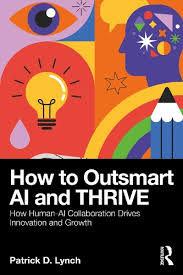
Hult’s AI Faculty Lead, Patrick Lynch, has spent years studying how humans and AI can work together without losing what makes human judgment irreplaceable. His new book, How to Outsmart AI and Thrive, will be on the shelves on July 29.
Ahead of the launch, we spoke to him about the misconceptions holding leaders back, what businesses need to do to move forward, and what you should do this Monday morning.
Hult: Your book opens with a provocative idea: AI may not take your job, but it will change what it takes to do it. What’s the most common misconception you see business leaders holding onto about AI and the future of work?
Patrick: The most common misconception is very expensive: leaders treat AI as a project. Projects end. AI is a practice. AI compounds. Get that wrong, and you feed both sides of the AI panic: the doomers who say it’s coming for our jobs and the hype crowd who say it’ll remake everything overnight (often the people selling us the tools).
If the question is, will AI replace some tasks and augment others? The answer is yes. And yet, Daron Acemoglu, a Nobel Prize-winning MIT economist, doubts any occupation that exists today will be eliminated in five or ten years. Instead, leaders should invest in changing what it takes to do jobs, tapping into new capabilities, and creating new value over cost-cutting. That’s augmentation over imitation.
“Leaders should invest in changing what it takes to do jobs, tapping into new capabilities, and creating new value over cost-cutting.”
H: Creating new value over cost-cutting feels like an important distinction. How can business leaders make sure they’re doing this right?
P: Using AI technology to imitate what you already do, just faster, is a trap I call “vanity AI.” The alternative, viable AI, is using AI to create value you couldn’t create before. That often takes collaboration with AI tools, people, or both. To get there, you reimagine the jobs and the teams.
Yesterday’s silos, with people in one box and data in another, are wrong for work where the value comes from collaboration.
H: Can you give us an example of how viable AI works in practice?
P: Two studies drew the line between when viable AI works and when it doesn’t. At Procter & Gamble, they took nearly 800 professionals, split them into individuals and teams, gave half of them AI and half nothing, and had them brainstorm new products. The teams working with AI generated more creative solutions and did it faster than the people working alone.
The second study gave the same AI tool to employees at IG, a UK financial services firm, split across writers, marketing staff, and developers. Everyone planned equally well with AI.
However, only the people with existing marketing expertise could turn that plan into a promotional pitch. That’s good news for educators, because foundational knowledge and skills still matter, maybe matter more than ever, to get value from AI.
“Foundational knowledge and skills still matter, maybe matter more than ever, to get value from AI.”
H: In your book, you draw on other stories from companies like Stitch Fix, GitHub, and JPMorgan Chase. Was there a moment from one of those organizations that genuinely surprised you? Something that shifted your own thinking about how AI and humans can work together?
P: The real surprise came from stepping back and looking across companies. Two things really stand out, both about expectations we set too high and too fast.
The first is the productivity paradox. In 1987, after a decade of heavy IT spending, economist Robert Solow wrote, “You can see the computer age everywhere but in the productivity statistics.” Nearly forty years later, economist Torsten Slok said almost exactly the same thing about AI: “AI is everywhere except in the incoming macroeconomic data.”
A February 2026 NBER survey of roughly 6,000 executives found nearly nine in ten firms have seen no measurable dent in productivity or employment from AI in three years.
What surprises me is our impatience and amnesia. Electricity took about forty years to show up in the productivity data. The last computing wave took about twenty. In November 2022, ChatGPT launched the democratized generative AI era, and it’s too early to call it a bust on tonight’s evening news. Give it a beat. Roll up your sleeves and be the change you want to see. There is a need and obligation to do so because the future of education and work depends on it.
The second surprise cuts the other way. AI is supposed to save time, and, in plenty of ways, it does. But an eight-month study tracking AI use at one company found the opposite happening. One engineer put it, “You had thought that maybe, because you could be more productive with AI, you could work less. But then really, you don’t work less. You just work the same amount or even more.”
The study found that as people used AI, their work intensified and blurred boundaries between jobs. Prompting an AI feels more like chatting than laboring, and multitasking climbed as people used AI alongside their own effort rather than in place of it. AI is expanding what we ask of ourselves and others nearly as fast as it saves us time.
“Roll up your sleeves and be the change you want to see. The future of education and work depends on it.”
H: Many professionals must be feeling that AI is expanding what we expect from ourselves. Part of that must be associated with the fear of humans being replaced by AI.
P: What’s surprising is that we keep forgetting we’ve been here before. Remember when automated teller machines (ATMs) made cash accessible at every corner store? That cut the number of bank tellers per branch by about a third.
But, because branches got cheaper to run, banks opened roughly 40% more of them, so total teller employment nearly doubled in the following decade. The tellers who remained shifted work, moving from clerk tasks into relationship-driven work, selling credit cards, loans, and investments, and solving customer problems. Economist David Autor frames this best when he explained that automating part of a job increases the value of the human tasks that remain.
As this scales, I anticipate that the organizations five years from now will look different from the ones we have today, because so much of this is still being built, tested, and renegotiated. And, the last time I checked, that kind of change is exactly what spurs learning, builds expertise, and gets people ready to do something with it. Worry less. Inspire more. Get on with the work.
“Automating part of a job increases the value of the human tasks that remain.”
H: You talk about embedding human values into AI systems from the start. Who owns that responsibility, and how do you stop it from becoming just another compliance checkbox?
P: The short answer to “who owns it” is: you do. Not the legal team, not a compliance officer. The days when a leader could hide behind an algorithm are gone.
In February 2024, Air Canada’s website chatbot invented a bereavement-fare discount the airline didn’t really offer. A grieving customer booked a full-fare ticket, trusting it would be refunded. Air Canada’s defense? It argued the chatbot was a “separate legal entity,” responsible for its own words, as if the bot should lawyer up on its own. The tribunal wasn’t amused and held the airline liable.
On the horizon, the EU AI Act’s high-risk obligations soon become binding, and GDPR’s Article 22 already gives people the right not to be subject to a fully automated decision with no human review. Regulators are converging on the same idea: accountability can’t be outsourced to a tool. It’s on you.
So, in practice, ownership isn’t a department. It’s a commitment every team makes and can’t automate away. While AI may run in your operations, someone still has to hold onto what your company is and is not. What it will and won’t do. It’s a leadership job.
H: A lot of AI leadership books are written for the C-suite. But transformation lives or dies at the manager and team level. What’s your message to the people in the middle who are trying to implement this without a clear mandate from above?
P: My message to the middle is that you have far more power than you think. You may not have a mandate, but you rarely need one to start. You need a prototype, a small win, and eventually a few aligned peers to scale it.
Take note of what Honeywell did. 95,0000 employees got access to generative AI. Leadership didn’t hand down a transformation plan or decide in advance which jobs would change. They did three things: invited employees to submit ideas for how to use the tools, prioritized those ideas by impact, and let the strongest ones scale. Sixteen use cases reached production. IT tickets dropped 80%. GitHub adoption among engineers hit 65%, adding 90,000 lines of code per week. That came from three things: access, invitation, and filter.
The World Economic Forum echoed this in its Four Futures for Jobs report. It suggests you pair your most AI-fluent junior person with your most experienced senior one on a real task. Let the junior show the senior what the tool can do. Let the senior show the junior where it gets it wrong. That closes a cultural gap while building an understanding of what works and what doesn’t.
Access is the part you may feel stuck on. Someone with authority needs to turn the tools on. But the invitation and filter are yours. Invite your team to find the tasks they’d love to hand off, then filter for the lowest-risk ones and pilot those. Start small, fail cheap, and scale only what proves itself.
BCG estimates about 70% of the value from AI adoption comes from people and process and only 10% from the technology itself. That 70% is sitting in your hands right now. Make it happen.
H: We’re at a moment where business schools are grappling with the same thing you pose to leaders: shape this moment or let it shape you. As Hult’s AI Faculty Lead, how do you think management education needs to evolve to produce graduates who are genuinely AI-ready, not just AI-aware?
P: AI tools are the easy part now. Decisions are the differentiator. That’s the difference between AI-aware and AI-ready.
AI-aware means you can define its components and rattle off differences between machine learning and large language models, passing a quiz on it. AI-ready means you can stand behind a decision you made with AI when someone pushes back on it. Too many business schools are still teaching the first thing and calling it the second.
Our accreditors, like AACSB, are already moving beyond the idea that AI competency means knowing how a model works. Newer fluency frameworks organize the skill around four habits: delegation, description, discernment, and diligence.
Anthropic tested that framework, analyzing thousands of conversations for its recent AI Fluency Index. Here’s the finding that should worry every business school: people are highly directive, good at describing what they want and delegating tasks to AI, but far less evaluative. When an AI’s output looks polished, people stop questioning whether it’s right. That’s discernment, and it’s the hardest to teach.
Today’s business students need metacognitive judgment skills: the ability to monitor their own thinking while using the tools. If schools are teaching students to be good individual users of AI tools, they are outdated and overmatched to meet future work demands.
What graduates need from the first day on the job is the ability to collaborate with hybrid teams—some humans, some agents—and know when to trust the work and when to challenge it. That’s a different skill than knowing how to prompt well. Business schools that build toward that will produce graduates who are AI-ready.
“When an AI’s output looks polished, people stop questioning whether it’s right. That’s discernment, and it’s the hardest to teach.”
H: Hult is launching the AI Lab this September as part of our postgraduate programs, where students will learn to design, deploy, and supervise AI agents in live business environments. From your research and experience, how critical is that kind of hands-on, applied learning compared to more theoretical approaches to AI education?
P: Very critical. You can lecture a student through a framework for evaluating AI output. You cannot lecture them into what it feels like to watch an agent miscue in front of a real client and have to decide, in the moment, what to do about it. That’s the whole case for hands-on learning over theory. Judgment is only real when something real is at stake.
That’s what a lab does that a lecture can’t. A student designs an agent, deploys it into a live business problem, and supervises it. They make the call on what to trust, what to fix, and what to shut down. They leave better prepared having already made those calls.
One thing I’m watching as this scales is how we prepare our graduates to lead change. Learning to re-role a team, to get creativity and accountability out of humans and machines together, is fast becoming the job itself. The AI Lab is the difference between a graduate who’s heard about AI and one who’s already led it.
“To get creativity and accountability out of humans and machines together is fast becoming the job itself.”
H: Your book is deliberately practical. You want readers to know what to do on Monday morning. What’s the one thing a business leader could do right now to start building a healthier relationship with AI in their organization?
P: A former Hult MBA student of mine, a self-described non-techie, just emailed to say he’d built his first AI app and shipped it as a Chrome extension. Now he’s sketching a product roadmap to add features and maybe turn it into a real business.
He didn’t need a computer science degree because he had something better: curiosity. Einstein put it better than I can: “I have no special talent. I am only passionately curious.” In a space changing this fast, that’s the whole strategy. The people getting ahead right now are the ones who keep asking “what if” after the first small win, technical background or not.
So, here’s how you start your own version of what he did: open whatever AI tool you already use. Tell it, “You’re my career coach, and my goal is to cut the routine work in my week and free up time for something better.”
Then, ask it to interview you with ten or twelve questions about what you really do all week: the tasks, the frustrations, and what you wish you had more time for. At the end, ask it to hand your answers back to you as a new version of your job.
Do that yourself before you ask anyone on your team to. That’s the whole first step. Everything that Hult grad built started with one curious question: what else is possible?
“The people getting ahead right now are the ones who keep asking: what if.”
__________________________________________