

One Debate, Three Disciplines: How MUN Brings Psychology, Economics & Politics to Life
 Tess Henderson,
2 hours ago
3 min read
Tess Henderson,
2 hours ago
3 min read
Picture a room full of delegates representing 50 countries. The topic: a global refugee crisis. Over three days, they’ll negotiate solutions, defend positions they may not personally agree with, and try to build consensus across competing interests.
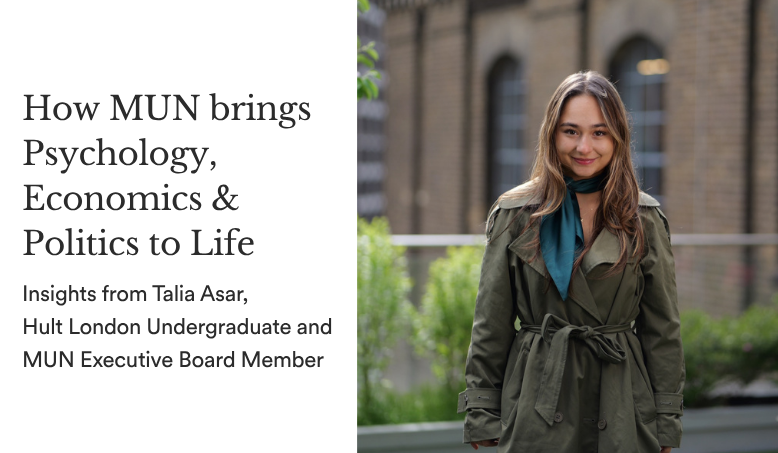
This is Model United Nations. And for Talia Asar, a Hult London undergraduate and member of the MUN executive board, it’s where three disciplines collide:
“When you try to solve a problem in MUN, you can’t just say ‘I’ll fix it,'” she explains. “You need funding—that’s economics. You need short-term and long-term plans—that’s politics. And you need to understand how people will react—that’s psychology.”
That same logic sits at the heart of Hult’s new Bachelor’s in Psychology, Economics & Politics (PEP) program. The three disciplines aren’t taught in silos. They’re taught as one interconnected way of understanding the world.
Politics: Representing a country, not yourself
In MUN, every delegate is assigned a country with its own foreign policy, alliances, and values. Your job is to represent that country 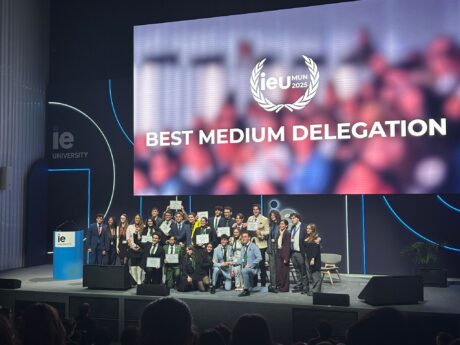 faithfully—even when you disagree.
“You go as a representative, not an individual,” Talia says. “You can’t go against your country’s values. You learn the skills of diplomacy by doing diplomacy.”
That’s PEP’s politics component in action: understanding how power operates, how alliances form, and how negotiation works across cultures.
Economics: Every solution needs a plan
Propose a policy in MUN without a funding mechanism, and you’ll get challenged immediately. Delegates learn to think in terms of trade-offs, resource allocation, and long-term sustainability.
“You need to find a way of funding,” Talia explains. “You need short-term solutions and long-term plans.”
This is economic thinking applied under pressure—the same analytical lens PEP students develop through coursework in behavioral economics and policy analysis.
Psychology: Reading the room
MUN isn’t just about the strength of your argument. It’s about understanding the people you’re negotiating with. When do you push? When do you concede? What motivates the delegate across the table?
“If you don’t understand psychology, you don’t understand your opponent—or your friend,” Talia says.
That’s the human behavior component of PEP: studying decision-making, group dynamics, and the cognitive biases that shape how people act—especially under pressure.
Why the combination matters
“So many degrees only look into one aspect,” Talia says. “But when you have a business, you’ll need to understand every part of it. When you want to climb the career ladder, you’ll need to understand every aspect.”
PEP is designed to close those gaps. And MUN is an immersive way to see all three disciplines working together in real time.
Why London?
The program is based in London for a reason. The city is a global hub for politics, finance, and international affairs—with direct ties to EU policy, US relations, and a student body representing 130+ nationalities.
“You’re connected to every part of the world,” Talia says. “And you talk to so many diverse people who tell you about their own countries.”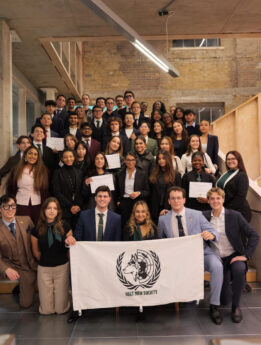
Through MUN, Hult students also build networks with politics and international relations students from LSE, King’s College, and universities across Europe. These connections extend well beyond competition.
Theory meets practice
For Talia, now applying for a master’s in international relations, politics, and diplomacy, MUN has been the proving ground for everything she’s learned.
“You don’t just learn the theory. You really put it to use.”
That’s the promise of PEP—and the opportunity waiting for students ready to see the full picture.
Today…
At the time of publishing, we were very excited to hear that HultMUN stands as the Best Large Delegation at Harvard WorldMUN, which took place in Lima. We couldn’t be more proud of our students!
Start your journey today and explore the Psychology, Economics & Politics program at Hult London: hult.edu/pep