Hult x Lovable: Sophie Alme Turns Ideas Into Working Applications
 Ulisha Singh,
4 months ago
5 min read
Ulisha Singh,
4 months ago
5 min read
Starting in September 2026, our Computer Science for Business program will partner with the AI-powered development platform Lovable to embed real product development into the classroom.
What does this mean for students in practice? We asked current Hult student Sophie Alme, who is already using Lovable, to tell us what it’s like building real applications and products through vibe coding as part of her learning experience at Hult.
Hult: How did you first come across Lovable, and what stood out to you about it?
Sophie: I first discovered Lovable when I was interning at a small investment firm in Stockholm in 2024. At the time, it was still in its early stages as an open-source GPT-based project. What stood out to me was how it enables people to build software simply by describing what they want. It makes software creation much more accessible and allows more ideas to come to life.
“Now, far more people can build, which makes innovation more accessible and allows more ideas to come to life.”
H: What inspired you to build a sourcing tool—what problem were you trying to solve?
S: I’m interested in venture capital and potentially founding my own startup, so I’ve been trying to source companies, ideas, and trends I find interesting. The challenge is that startup activity happens across so many platforms, communities, newsletters, and social channels that it can be hard to track everything in a structured way.
I wanted to build something that could help me surface promising startups earlier, organize what I’m finding, and make the sourcing process feel more intentional rather than scattered across notes, tabs, and random links.
H: How did you use Lovable, and what was the process like?
S: I used Lovable as a full-stack development platform. I described what I wanted—a sourcing tool for venture capital, along with the core goals—and it generated the code, backend, and database setup for me. The process was very iterative: I would describe a feature, review what was built, and then refine it step by step.
I started with the core idea of a signal ingestion system that pulls information from sources like Reddit, Hacker News, GitHub, RSS feeds, YouTube, and other public platforms. From there, I expanded it into a system that could normalize and store those inputs in one place. I then layered in AI to automatically score and categorize signals, helping separate noise from potentially interesting early-stage signals.
H: Where is the sourcing tool currently in its development?
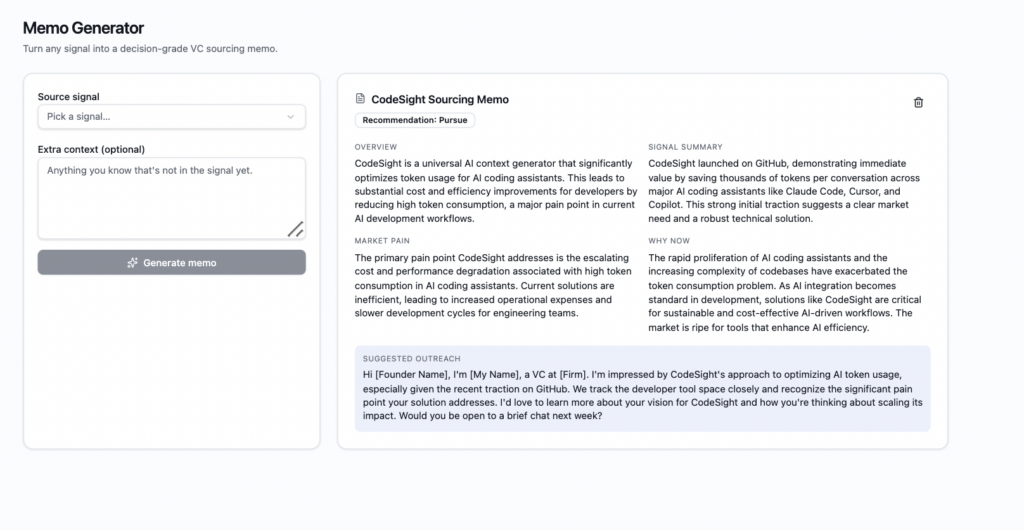
S: It’s not fully production-ready yet, but the core pipeline works end to end. Data is collected, stored, scored, and categorized, and I can review everything in a structured queue and generate investment memos. I’m still refining the scoring models and adding more data sources, but the proof-of-concept already works with real data.
H: What else have you built with Lovable?
S: For one of my business strategy classes, I used Lovable to build out an idea before the final presentation. It helped me communicate the concept more clearly to my teammates and shaped how we structured the final report.
I’ve also used it for passion projects. One example is a Scandinavian-inspired workout studio concept I’ve always thought about—I built a landing page for it. I haven’t launched it, but it’s been useful for quickly testing how an idea feels before committing real time or resources. I’m also planning to use it to build an alumni database for the Hult Investment Group on campus.
H: What would you say to a fellow student who wants to start building but doesn’t know where to begin?
S: Start with a problem you personally understand. It doesn’t need to be a huge idea at first. The most important thing is to build a simple first version, because making something tangible teaches you much faster than just thinking about it. One thing I’ve learned at Hult is how quickly ideas can turn into something you can test and build. There are now so many tools and resources available online that starting to build is much easier than people think.
“One thing I’ve learned at Hult is how quickly ideas can turn into something you can test and build.”
H: Do you see this sourcing tool as something you could use professionally?
S: Right now, it’s mainly a learning experiment. Building it has been a way to explore ideas, develop product instincts, and better understand how venture sourcing and research can be structured using data and signals from different sources.
At the same time, it reflects a workflow I already find useful, so I plan to keep refining it and could see it becoming part of how I approach sourcing and analysis over time.
H: What’s been your biggest takeaway from building with these tools?
S: I’ve learned that execution can start much earlier than you think. You don’t need to have everything fully figured out before building a prototype. Building helps clarify the idea, the user, and the problem in a way that planning alone cannot. Today, there are also so many tools and resources available that starting to build is much easier than people think.
“You do not need to have everything fully figured out before creating a prototype.”
______________________
Have the drive to turn ideas into working products throughout your degree? Apply now to our Bachelor’s in Computer Science for Business.