

“Students aren’t expected to come in with a venture. They’re expected to build one here.”
 Tess Henderson,
4 months ago
4 min read
Tess Henderson,
4 months ago
4 min read
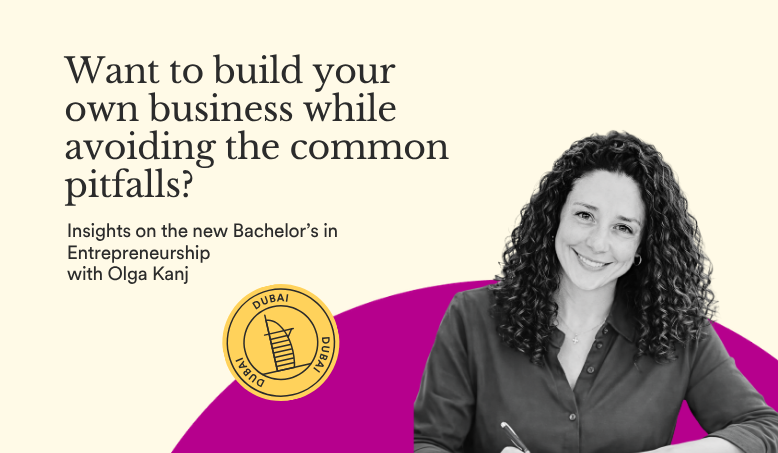
We sat down with Olga Kanj, Academic Director of Hult Dubai’s new Bachelor’s in Entrepreneurship, to find out what it really means to learn entrepreneurship by doing it.
You’ve just taken the lead on Hult’s Bachelor’s in Entrepreneurship in Dubai. What’s your philosophy on how entrepreneurship should be taught?
Entrepreneurship should be taught through doing, iterating, failing, and trying again, because creating something new can’t be learned through theory alone. The program provides strong foundational pillars, from structured thinking to research-based insights, while still giving students the space to take risks and test ideas in practice.
The real value lies in combining intellectual rigor with hands-on venture creation through the Venture Studio. By enabling students to build, experiment, and learn from real outcomes, education moves from abstract concepts to actual execution.
How are the students supported to learn entrepreneurship in this hands-on way, connecting them to the real world?
A key part of the program is the Venture Studio. This functions as an embedded incubator, providing mentorship, structured sprints, and direct feedback from entrepreneurs and operators. Students are constantly exposed to the ecosystem through events, speaker sessions, and field experiences,building both network and real-world context.
The Venture Studio connects directly with Dubai’s entrepreneurship environment, giving students the structure, mentorship, and credibility to navigate real execution. That combination of speed, access, and low friction is what turns entrepreneurship from something theoretical into something they can actually do.
You bring up Dubai as a place where student entrepreneurs can start a business, not just study one. What does that look like in practice?
Dubai is a live market students can plug into almost immediately. In practice, that means they’re not stopping at pitch decks. They’re registering licenses through free zones, testing ideas with real customers, and even generating early revenue while still in the program.
Instead of simulated projects, they’re working on actual ventures with access to founder networks, global events like GITEX, and government and corporate challenge programs where startups can test solutions with real institutional partners. The Venture Studio sits within this ecosystem, allowing students to build and validate ideas in a real market, not in isolation. Dubai provides a rare combination of demand, access, and support, making it possible to test, launch, and scale ventures while still studying.
What does the program look like day-to-day?
Day-to-day, the program is built around doing, not just pitching, with the Venture Studio at its core. In the first two years, students go through repeated build–iterate–fail–build cycles through venture studio work and challenge-based projects that are part of their academic credit. They work on their own ideas while also being pushed to create and test new ventures, forcing them to think beyond their initial assumptions and collaborate with different teams.
In the final two years, students shift from exploration to scale by choosing one of four focused streams: Startup, Deep Tech, Family Business, or Innovation. Each stream supports how they grow their venture within the Venture Studio environment. Combined with courses designed to support what they are building, this ensures they don’t just learn how to pitch a business, they learn how to build, validate, and scale one.
What does success look like for a graduate of this program, and what do they have that other business graduates don’t?
Success isn’t defined by whether graduates start a company immediately, it’s defined by their ability to operate in uncertainty, create value, and execute ideas in real environments. By the time they graduate, students have already built, tested, and iterated on multiple ventures, worked across teams, and made real decisions under pressure through the Venture Studio.
What they have that other graduates often don’t is experience, not just knowledge. They understand how to move from idea to execution, how to validate opportunities, and how to adapt when things don’t go as planned. These are the same capabilities employers increasingly value, problem-solving, adaptability, and entrepreneurial thinking.
Ultimately, they don’t just understand how businesses work. They know how to build and operate them.
What kind of student thrives here, and what would you say to someone who’s never started a business before?
The students who thrive aren’t the ones who already have everything figured out, they’re the ones who are comfortable not having the answers yet. They are curious, proactive, and willing to test ideas, get feedback, and adjust quickly without taking failure personally. They don’t need prior startup experience, but they do need a bias toward action and the discipline to follow through.
For someone who has never started a business before, that’s not a disadvantage — it’s exactly where they should start. The program is designed to teach entrepreneurship by doing, so students aren’t expected to come in with a venture. They’re expected to build one here. Through the Venture Studio, they’ll work on real ideas, make decisions, and learn from real outcomes, with the right level of guidance and support.
By the time they graduate, they won’t just understand entrepreneurship. They’ll have practiced it in real conditions.
Interested in the Bachelor’s in Entrepreneurship at Hult Dubai? Find out more.