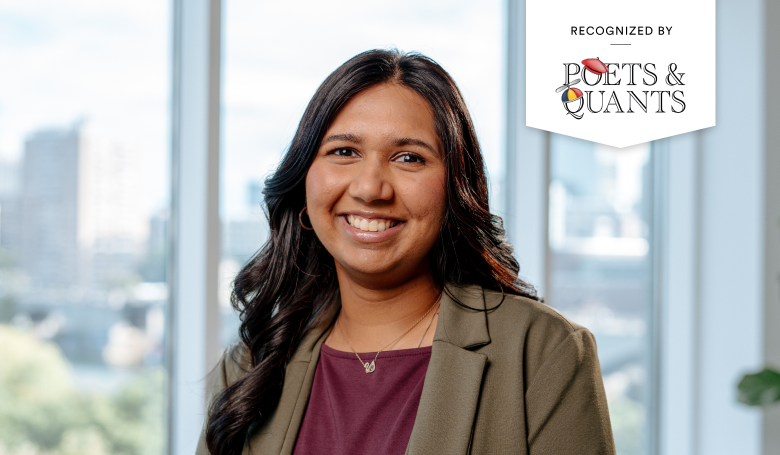
Anusha Vissapragada Recognized as One of the 50 Best Undergraduate Business Professors by Poets&Quants 2025
 Ulisha Singh,
4 months ago
3 min read
Ulisha Singh,
4 months ago
3 min read
We’re proud to announce that Hult Professor Anusha Vissapragada has been named among the 50 best undergraduate business school professors by Poets&Quants, becoming the first female undergraduate faculty member at Hult to receive this recognition.
For anyone who’s taken a class with Anusha, it’s easy to see why she’s being honored. On campus, she’s known for her innovation, expertise, and passion for helping students leverage data to make a difference.
As faculty lead for computer science and business analytics at Hult Boston, she helped design the school’s first undergraduate STEM analytics pathway. Her courses combine data science with hands-on projects, where students have generated over 1 million USD in value by advising nonprofits, small businesses, and healthcare organizations.
Anusha’s research explores how AI and human intelligence intersect in education, and she frequently speaks on the future of AI in learning—including through her TEDx talk and Voices of Hult podcast. She is the author of two textbooks: Introduction to Business Analytics and Regression and Databases and Quantitative-Based Decision Making.
Before joining Hult in 2023, Anusha held analytics and strategy roles at Barclays, Sema4, and Mashreq Bank. She holds an M.S. and a B.S. from the University of Connecticut and is pursuing an Executive Ph.D. at Bentley University.
“Education is the most powerful tool for creating change. I bring that belief to my teaching every day, blending data with empathy and technology with purpose.”
Read our Q&A with her below to get to know her a bit better and see why she’s rated so highly by our students and as an industry expert.
Q: What do you think makes you stand out as a professor?
A: I treat every course like a startup. Each class has a goal, a plan, and a measurable impact. Students learn through real projects, not simulations. They work with live data, design models, and present insights to actual organizations. My role is to guide them as they connect the dots between data, strategy, and human behavior. That entrepreneurial spirit—combined with an emphasis on empathy and ethics—defines my teaching.
Q: What do you enjoy about teaching business?
A: Business students are curious and action-oriented. They don’t just want to understand models; they want to know how to use them to make better decisions. I love the moment when a student realizes that analytics can be versatile—that data can tell a story or drive change. Those realizations turn a technical exercise into something personal and exciting.
Q: What is the most challenging thing about teaching business?
A: Teaching students that analytics is rarely black and white. There’s often more than one correct answer, and the right choice depends on context, ethics, and human judgment. Helping students get comfortable with uncertainty can be difficult, but it’s also what makes the field so rewarding.
Q: Tell us a bit about your current research
A: My current research explores how large language models can support learning in business analytics. The most interesting discovery so far is that when students use AI tools intentionally, their curiosity and confidence grow. When guided correctly, AI doesn’t replace human reasoning; it strengthens it. It helps students explore ideas, reflect on outcomes, and think about problems in ways they hadn’t before.
Q: In one word, describe your favorite type of student
A: Creative
Q: How do you think your students would describe your grading?
A: Fair and constructive. My feedback is specific and focuses on how to grow. I want students to see grades not as an endpoint, but as part of the learning process.
Want to get a feel for learning with Anusha? Watch her TEDx talk on AI and Human Intelligence to learn how the two can work together rather than compete.
Congratulations, Professor Vissapragada on your recognition from Poets&Quants! We’re very lucky to have you on campus.