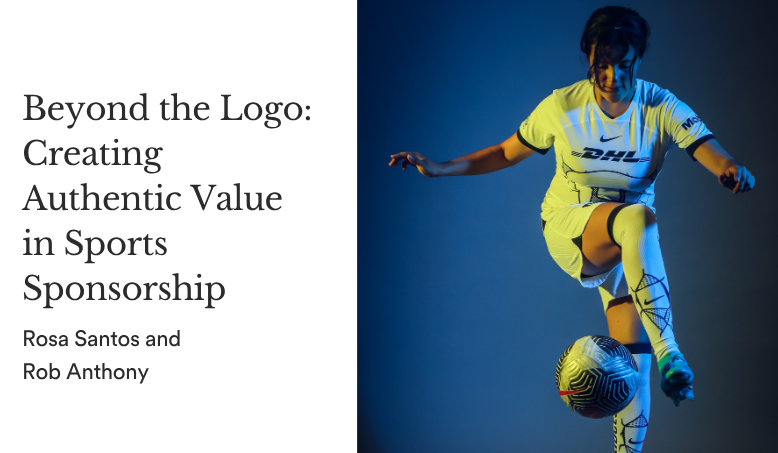
Beyond the Logo: Creating Authentic Value in Sports Sponsorship
 Hult International Business School,
6 months ago
4 min read
Hult International Business School,
6 months ago
4 min read
This post is one in a series on the business of sports, curated by Hult professors Tom Sullivan and Rob Anthony and leading up to the 2026 FIFA World Cup. The content series highlights the intersection of business and the global sports industry, and what they can learn from each other.
Beyond the Logo: Creating Authentic Value in Sports Sponsorship
Rosa Santos and Prof. Rob Anthony
For decades, sports sponsorships were rooted in a simple assumption: more logo exposure generates more awareness, preference, and sales.
This model once dominated thinking about brand value, but it no longer reflects how fans consume sports or how brands create value. Visibility still matters, but only as a starting point.
Several forces are driving brands toward deeper, more authentic collaboration:
- Fans expect values, purpose, and social contribution
• Data allows brands and sports organizations to co-design experiences for fans
• Athletes act as cultural leaders, requiring authenticity in brand partnerships
• Long-term trust produces better outcomes than short-term visibility
Today’s most effective sponsorships focus on shared value, not signage. Brands invest to shape the fan experience, innovate alongside sports organizations, and contribute to communities. The most impactful sponsorships now function as strategic alliances, not visibility purchases.
The World Cup, as one of the most influential stages in global sport, both mirrors and magnifies these developments. Its ecosystem of partnerships demonstrates the shortcomings of passive exposure and sets the pace for a new era of integrated, value-creating collaboration.
Qatar Airways’ partnership with FIFA is a prime example. Rather than functioning as a logo sponsor, the airline helped design the travel, hospitality, and cultural ecosystem of the World Cup. Their involvement touched every step of the fan journey, from curated travel programs and digital wayfinding tools to destination branding. This partnership demonstrates how sponsorship has become a vehicle for holistic experience design.
Another example from the World Cup’s global stage illustrates these dynamics. Coca-Cola has shaped its involvement far beyond branding to include youth football development, global fan activation, and community-based engagement. Its leadership in grassroots tournaments, trophy tours, and digital fan storytelling exemplifies sponsorship as credible, long-term, and emotionally resonant cultural participation.
Yet developments do not stop there. The next stage in sponsorship evolution is co-design, where brands and governing bodies build new products, experiences, technologies, and platforms together. This deeper integration transforms sponsorship from a marketing channel into an ecosystem of shared innovation. Several dimensions of this co-design model are already visible at the World Cup.
- Athlete-informed product innovation
Adidas’ partnership with FIFA is one of the clearest expressions of this trend. Adidas does not merely supply equipment —it co-creates it. Every official World Cup match ball is the result of years of athlete testing, aerodynamic modeling, material experimentation, and sustainability research. The collaboration extends to referee technologies, training tools, and grassroots development programs. This is product innovation embedded directly into the sponsorship model, with brand and sport co-evolving together.
- Fan co-creation and digital participation
Modern fans do not simply watch the World Cup. They help shape it. Digital platforms, many built or supported by sponsors, allow fans to create content, participate in challenges, vote on campaign elements, and influence narratives in real time. Fan-generated moments increasingly become part of the tournament’s cultural footprint, signaling a shift from monologue to participatory ecosystem.
- Purpose-driven community collaboration
Brands and sports organizations now co-design socially meaningful initiatives. At the World Cup, these include youth academies, accessible football programs, community festivals, and inclusion-focused projects. Coca-Cola, adidas, and regional partners have all supported efforts that extend football’s impact far beyond stadium walls and root sponsorship in shared social purpose.
- Narrative co-creation with athletes
The stories surrounding the World Cup are no longer crafted solely by broadcasters. Athletes co-create narratives through documentaries, behind-the-scenes access, social content, and brand-supported media channels. Partners increasingly collaborate with athletes as creators, building narratives alongside them rather than treating them as merchandising assets.
In this environment, sponsorship becomes an ecosystem— a network of co-created experiences, products, stories, and community initiatives that extend far beyond the boundaries of the matches themselves. The sponsor’s role expands from financier to collaborator, innovator, and cultural participant. Adidas’s partnership with FIFA exemplifies this broader evolution, demonstrating how innovation, technology, athlete insight, and community engagement now sit at the heart of modern sponsorship.
The World Cup makes the transformation unmistakable. Sports sponsorship has moved from logo exposure to long-term value creation and from transactions to collaboration. Brands co-create with sports organizations to shape experiences, innovate products, and support communities, defining the future of the sports marketplace.
Sidebar: Transformative World Cup Partnerships at a Glance
| Partner | Nature of Partnership | Why It Represents the Future |
| adidas + FIFA | Co-created match balls, technologies, training systems, development programs | Shows how sponsorship fuels innovation and system-wide value creation |
| Coca-Cola + FIFA | Youth development, fan activation, community programs, immersive engagement | Demonstrates how purpose-driven partnerships deepen cultural relevance |
| Qatar Airways + FIFA | Fan journey design, travel architecture, digital integration, experience creation | Illustrates how sponsors help design the event ecosystem itself |