
When building gets easier because of AI, the real question is: What should you build?
 Henrik Totterman,
3 weeks ago
14 min read
Henrik Totterman,
3 weeks ago
14 min read
How customer value creation helps students move from ideas to market while developing the human skills that increasingly matter in business.
The process of turning an idea into something tangible is changing remarkably quickly. Students can now use generative AI to brainstorm alternatives, analyze markets, develop concepts, write code, create prototypes and prepare professional-looking presentations in a fraction of the time these activities once required. That is exciting, and I want students to use these tools. At the same time, faster production introduces a less obvious challenge: if it becomes easier to build almost anything, deciding what is worth building becomes considerably more important.
The challenge is becoming visible in software development. Demirer, Musolff and Yang (2026), studying more than 500,000 software developers, find substantial increases in coding activity following the adoption of successive generations of AI coding tools. Yet those gains diminish considerably as work moves from writing code toward completed releases. Their analysis of major software marketplaces shows a similar pattern: new-app creation has accelerated sharply since the rise of agentic coding tools, while usage has not kept pace. They also observe considerably more experimentation along the way, including more code being rewritten, more branches being created and more projects ultimately abandoned.
One example is wearable technology. Bose approached smart eyewear with its Frames product, combining conventional sunglasses with open-ear audio, calls and voice assistance. The product was initially part of a broader vision for audio augmented reality. Bose presented its AR platform as designed for everyday use but wound down the initiative in 2020 after it failed to meet expectations. A Bose spokesperson said at the time that the technology had found specific use cases but not broad daily use. Bose continued developing audio-focused Frames for a period, but its broader augmented-reality ambition had not generated the hoped-for market.
Today, Meta and EssilorLuxottica are approaching essentially the same product category in a different way, integrating cameras, open-ear audio, voice interaction, translation and AI into familiar Ray-Ban and Oakley eyewear. Adoption has been substantially broader: Meta reported millions of Ray-Ban Meta units sold, while EssilorLuxottica reported that sales of its Meta AI glasses exceeded seven million units during 2025. The interesting question is therefore not simply whether the underlying technology has improved, which it clearly has, but whether the value proposition is now better connected to recognizable customer jobs and everyday behavior.
For business educators, that distinction matters. Students today are often very good at generating ideas. Yet when the conversation moves from enthusiasm to market reality, the questions become harder. Who exactly is the customer, not simply as a broad segment or invented persona, but in sufficiently concrete terms that we can understand their situation? What problem or unmet need is important enough to solve? What are customers doing today instead? Why would they change their behavior? And how will value be delivered, captured and measured over time?
These questions expose the distance between a promising idea and a credible market opportunity. Christensen, Hall, Dillon and Duncan (2016) make a related point through the Jobs to Be Done perspective. Organizations may know a great deal about customer characteristics and still fail to understand the progress customers are trying to make in a particular situation. Innovation becomes more useful when we understand the job the customer is trying to accomplish rather than relying primarily on customer categories or product characteristics.
This has influenced how I teach. Students can become very good at talking about solutions before determining whether the underlying problem deserves to be solved at all. In my classes, we therefore intentionally spend time in the problem landscape. Students frame assumptions, conduct primary research, seek supporting evidence and repeatedly test whether their interpretation of the customer is correct. I encourage them, somewhat provocatively, to fall in love with the customer problem before even considering solutions.
Generative AI makes that discipline more, not less, important. Large language models are enormously useful for exploring possibilities, identifying questions, locating patterns, challenging assumptions and accelerating research. But plausible output is not the same thing as market evidence. AI can help us think about a customer; it should not prevent us from talking to the customer.
From idea generation to customer value creation
The broader shift is from treating innovation primarily as idea generation toward treating it as a discipline of customer value creation. Markets do not reward ideas simply because they are interesting or technologically possible. Ultimately, someone must find the resulting value proposition sufficiently relevant to choose it over available alternatives.
A credible value argument therefore has to withstand a demanding sequence of questions:
- Who are we really serving?
- What are they trying to accomplish?
- What makes the current situation frustrating, costly, risky or otherwise worth changing?
- What alternatives and workarounds already exist?
- What would make our proposed solution sufficiently better to justify switching?
- What capabilities are required to deliver that promise reliably?
This idea is well established in research on customer value propositions. Anderson, Narus and Van Rossum (2006), for example, argue that effective value propositions should concentrate on the benefits that matter most to target customers and provide credible evidence of the value being claimed, rather than presenting an indiscriminate catalogue of benefits. This remains one reason I view customer value creation not as a narrow marketing topic, but as a bridge between marketing, strategy, entrepreneurship, product management and organizational execution. It connects an understanding of the customer with choices about what a company should offer, prioritize, build capabilities around, take to market and ultimately measure.
The timing is also relevant from a skills perspective. The World Economic Forum’s Future of Jobs Report 2025, based on responses from more than 1,000 leading global employers representing more than 14 million workers, identifies analytical thinking as the top core skill for employers. Creative thinking, leadership and social influence, and curiosity and lifelong learning also rank among today’s core skills and among the capabilities expected to increase in importance as work continues to change.
Hult’s own research points in a similar direction. In a survey of 800 U.S. HR leaders and 800 recent graduates working in business roles, employers identified communication, curiosity and willingness to learn, collaboration, creativity and critical thinking as particularly important capabilities for new hires. Communication was cited by 98% of HR leaders, curiosity and willingness to learn by 93%, collaboration by 92%, creativity by 90% and critical thinking by 87%.
The educational challenge, then, is not simply to tell students that these capabilities matter. It is to create situations in which they must use them to solve meaningful business problems.
A framework for moving from problem to market
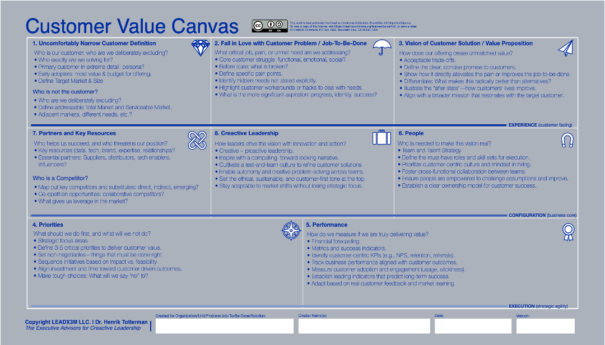
In my teaching and executive education work, I use an eight-part Customer Value Canvas for this purpose. The framework is intended to create a portable value argument that can travel from early exploration to market execution and hold up in conversations with customers, managers and executives.
The sequence begins with customers and noncustomers, followed by the customer problem or job to be done, and then the solution and value proposition. Only after those foundations come priorities, performance, people, partners and key resources, and Creative Leadership, my term for combining creative thinking with proactive leadership and execution. The wider methodology moves iteratively through Engage, Explore and Execute: deciding which problem is worth pursuing, reducing uncertainty through customer and market learning, and moving what has been validated toward implementation.
Students and executives work with the one-page canvas shown below. Its purpose is to make the whole value-creation system visible rather than treating customer discovery, strategy, organization and execution as separate conversations.
Figure 1. Customer Value Canvas: A practical tool for moving from customer problem to market execution
Source: Totterman (2026), Customer Value Creation framework.
I do not ask participants simply to “fill in the boxes.” We begin by treating the content as a set of hypotheses. The first three areas receive disproportionate attention, with five questions at the center of the work:
- Who exactly is the customer?
- What are they trying to accomplish?
- What is getting in the way today?
- What alternatives or workarounds already exist?
- What would have to be true for our proposed solution to represent a meaningful improvement?
The distinction between customers and noncustomers is particularly useful because asking whom we are not trying to serve creates discipline. The customer problem is articulated without reference to the proposed solution, and only after that do we begin shaping the value proposition and asking what would make someone change from the status quo.
The remaining areas force the idea into organizational reality:
- Priorities require choices about what should happen first and what should wait.
- Performance asks for evidence that customer and business value are being created.
- People make capability and ownership explicit.
- Partners and key resources surface dependencies and ecosystem opportunities.
- Creative Leadership considers how leaders enable experimentation and adaptation without losing strategic focus.
The canvas is also meant to be revisited. New evidence may change the problem definition, which may alter the value proposition, priorities, capabilities, partners and measures. Customer value creation is therefore less a linear eight-step checklist than an iterative discipline for progressively replacing assumptions with evidence.
Where the Five Cs enter the process
The educational value of the canvas is that repeatedly working with it and challenging its assumptions naturally exercises Hult’s Five Cs.
| Customer Value Canvas area | Practical question | Five Cs most visibly exercised |
| 1. Customers and noncustomers | Who are we specifically serving, and whom are we deliberately excluding? | Curiosity, critical thinking |
| 2. Customer problem/job to be done | What is the customer trying to accomplish, and what makes that difficult today? | Curiosity, critical thinking |
| 3. Solution/value proposition | Why should the customer change from the current alternative? | Creativity, critical thinking, communication |
| 4. Priorities | What happens first, and what will we deliberately not do yet? | Critical thinking, collaboration |
| 5. Performance | What evidence tells us that customer and business value are being created? | Critical thinking, communication |
| 6. People | What capabilities, roles and ownership are necessary to deliver the promise? | Collaboration, communication |
| 7. Partners and key resources | Who and what do we need beyond the immediate organization? | Collaboration, curiosity |
| 8. Creative Leadership | How do we learn and adapt while maintaining direction and accountability? | Creativity, curiosity, collaboration, communication |
Curiosity becomes tangible when students investigate actual customer behavior and question assumptions. Critical thinking appears when they distinguish symptoms from underlying problems and evidence from assertion. Creativity becomes less about producing the greatest number of ideas and more about finding better ways to solve the right problem. Collaboration becomes unavoidable because value is rarely delivered by one function, while communication becomes the ability to articulate the value logic clearly enough that customers, colleagues and executives can understand and challenge it.
In this sense, a structured framework does not make human skills less important. It provides the practical setting in which those skills must perform.
From the classroom to executive practice
I see the same dynamic in my executive education and advisory work with leaders from publicly listed companies and international family businesses. Their scale and complexity may differ from a student project, but the core questions remain similar: Which opportunities deserve attention? Which customers should shape future growth? Does the value proposition still reflect changing needs? And can the organization deliver what it promises?
The framework gives leaders across commercial, product and finance teams a common language for examining those questions. It also encourages them to consider the perspectives of different B2B stakeholders, including economic buyers, end users, procurement leads, senior sponsors and operational owners. Each may have a different job to be done, set of incentives and definition of value. In complex relationships, there is rarely a single “customer.”
Mapping these perspectives across the customer life cycle, from evaluation and purchase through adoption, renewal and expansion, helps teams see where value is created, diluted or lost. The framework can also be applied across time by asking what created success in the past, what drives performance today and what may need to change in the future.
Comparing degree-level and executive education has strengthened my conviction that customer value creation is not primarily a classroom technique. Students are practicing the same reasoning experienced leaders need. The context becomes more complex and the consequences larger, but the discipline remains increasingly important in a rapidly changing AI era.
When human skills become commercial skills
Frameworks do carry a risk. They can become mechanical box-filling exercises in which completing the template replaces thinking. A finished canvas is no more evidence of good judgment than a completed spreadsheet is evidence of a sound investment. But there is an opposite risk as well: creativity, curiosity, collaboration, communication and critical thinking can remain abstract aspirations if we are never required to apply them where the answers are uncertain.
The educational value comes from combining the two. A student who can populate eight boxes without challenging assumptions has not learned very much. A student who uses curiosity to uncover an unexpected customer need, critical thinking to reject a weak assumption, creativity to reshape a value proposition, collaboration to reconcile functional perspectives and communication to defend that reasoning has developed something considerably more useful.
I would call that commercial judgment. It matters for students entering product management, product marketing, strategy, consulting, business development and entrepreneurial roles. Product managers must decide which problems deserve scarce development resources. Product marketers must translate customer understanding into positioning, evidence and a reason to switch. Strategy professionals must decide where an organization should and should not compete. Increasingly, all will have AI available to generate possibilities, analyze alternatives and accelerate execution.
That makes the ability to generate options less scarce. It does not make the ability to choose among them less important.
Teaching customer value creation is therefore not mainly about helping students invent more things. It is about helping them make better value decisions around customer-specific problems and opportunities. A structured framework connects customer understanding with strategic choice, functional collaboration, experimentation, execution and market evidence. That is one way human capabilities become commercially useful and business education moves closer to the realities students will face after graduation.
The recent evidence from AI-assisted software development offers a useful glimpse of where this may be heading. We may soon be able to produce dramatically more concepts, prototypes, applications, services and business ideas than markets could ever absorb. The constraint is unlikely to be our collective capacity to produce possibilities. The more difficult task will remain deciding which possibilities deserve to become real.
That is why customer value creation belongs near the center of modern business education. It teaches students not simply how to build, but how to understand what customers value, determine what is worth solving and create something capable of surviving contact with the market.
References
Anderson, J. C., Narus, J. A., & Van Rossum, W. (2006). “Customer Value Propositions in Business Markets.” Harvard Business Review, March 2006. https://hbr.org/2006/03/customer-value-propositions-in-business-markets
Bose Corporation (2018). “Bose Introduces Audio Augmented Reality Platform.” Bose. https://www.bose.com/pressroom/bose-introduces-audio-augumented-reality-platform
Christensen, C. M., Hall, T., Dillon, K., & Duncan, D. S. (2016). “Know Your Customers’ ‘Jobs to Be Done.’” Harvard Business Review, September 2016. https://hbr.org/2016/09/know-your-customers-jobs-to-be-done
Demirer, M., Musolff, L., & Yang, L. (2026). “Writing Code vs. Shipping Code: Productivity Effects Across Generations of AI Coding Tools.” NBER Working Paper No. 35275, May 2026, revised September 2026. https://www.nber.org/system/files/working_papers/w35275/w35275.pdf
EssilorLuxottica (2026). “Q4 and Full-Year 2025 Results.” Reports more than seven million AI-glasses units sold during 2025, including Ray-Ban Meta and Oakley Meta. https://www.essilorluxottica.com/cap/content/283060/
Fingas, J. (2020). “Bose Shuts Down AR Development.” Engadget, June 16, 2020. https://www.engadget.com/bose-ends-ar-development-211758625.html
Google (2023). “Glass Enterprise Edition Announcement.” Google Glass Enterprise Help. Google ceased sales on March 15, 2023. https://support.google.com/glass-enterprise/customer/answer/13417888?hl=en
Google X. “Google Glass: A Google X Moonshot. History of the Explorer and Enterprise Phases of Glass.” https://x.company/projects/glass/
Hult International Business School / Workplace Intelligence (2025). “New Survey Reveals Traditional Undergraduate Education Is Not Preparing Students for the Workforce.” Survey of 800 U.S. HR leaders and 800 recent graduates. https://www.hult.edu/blog/wi_skills_survey
Meta (2025). “Ray-Ban Meta (Gen 2): Ray-Ban Meta (Gen 2) Available Now With Up to 2x the Battery Life and Better Video Capture.” Meta Newsroom, September 17, 2025. https://www.meta.com/blog/ray-ban-meta-gen-2-now-available-ai-glasses-extended-battery-life-3k-video
Totterman, H. (2026). How to Work on Your Customer Value Creation Journey: A Practical Playbook for Strategy and Market Leaders Who Need Value Creation That Holds Up in the Boardroom.
World Economic Forum (2025). The Future of Jobs Report 2025. Geneva: World Economic Forum. https://www.weforum.org/publications/the-future-of-jobs-report-2025/
About the author
Henrik Totterman, D.Sc., is a Finnish American professor, executive advisor, entrepreneur and Honorary Consul of Finland who works at the intersection of customer value creation, strategy, innovation and leadership. He teaches at Hult International Business School and Harvard University and leads LEADX3M Executive Advisors. His advisory and teaching work focuses on helping leaders turn complex customer and market challenges into clearer choices, stronger value propositions and practical action. More at henriktotterman.com and in his Forbes column.