
Is Paying for Elite Players Always the Best Strategy?
 Hult International Business School,
6 months ago
4 min read
Hult International Business School,
6 months ago
4 min read
Alejandro Sánchez Díaz-Casanova & Michael de la Maza
For decades, the world of professional soccer has operated on a simple premise: if you want to win, you have to spend on the best players. The thinking is simple: the best players cost the most money. So if a club wants to win, it has to spend in the form of astronomical transfer fees and wages.
But are clubs making optimal decisions? Are they getting the best players at the best price? More importantly, is this premise the right business decision? Our work suggests that the answer to these questions is a resounding “no!” Our analysis reveals a systematic inefficiency across Europe’s top five leagues, where a staggering 95% of clubs fail to operate at the “efficient frontier.” For business leaders, this isn’t just about soccer. It’s about using analysis and data to examine long held assumptions.
The “Efficient Frontier”
In classical portfolio theory, a subfield of finance, the efficient frontier is the set of optimal portfolios that offer the highest expected return for a level of risk. We have adapted this framework to soccer, defining an “efficient club” as one that cannot improve its sporting outcomes (i.e., win-loss record) without worsening its financial returns (or vice versa).
Our model bridges two traditionally siloed departments:
- Financial: focusing on budgets, expenses, returns, and ROI from player salaries and transfer fees.
- Sporting: focusing on soccer strategy and tactics, training, and winning soccer games.
By treating financial results and sporting outcomes together, we can identify the “efficient frontier” in soccer.
How big is the inefficiency?
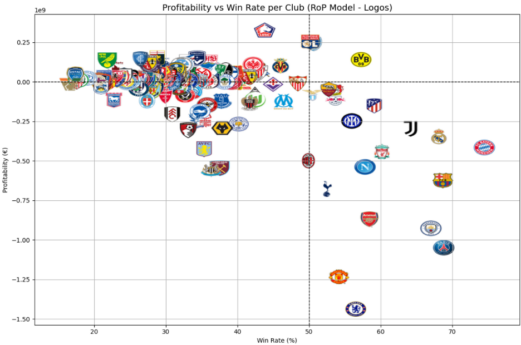
By examining data from 2015 to 2024 for the top five European leagues, we discovered a systematic overspending pattern. While transfer window spending rose dramatically during this period, the value of these investments was remarkably low.
Here are examples of the efficiency gap:
- In the Premier League alone, the average club performance was €77 million below the efficiency benchmark per season, amounting to an aggregate deviation of €617 million per club over the period.
- Over 40% of clubs are not profitable after accounting for all expenses.
Even global giants like Real Madrid, PSG, and Manchester City fall below the efficient frontier. While their sporting performance is very good, our model suggests that they are overspending to achieve their win-loss records.
Survival vs. dominance
In this model we identify two strategic pathways for club management, depending on the club’s objectives:
- Maximize performance: For elite clubs, the goal is sporting dominance while maintaining financial viability. The objective is to maximize win percentage while remaining profitable.
- Maximize returns: For mid-tier or other clubs, the priority is financial survival. These clubs maximize profit while maintaining a win rate that prevents relegation.
The “Millions to Efficiency Metric”: A tool for investors
The model quantifies the exact financial or sporting performance adjustment needed for a club to reach the efficient frontier. This metric, which we call “millions to efficiency,” can be used to identify clubs with latent upside. These clubs are likely to be good investments for private equity and investors, provided they can then manage the clubs in a way that moves them closer to the efficient frontier.
For an investor, an inefficiency is a financial opportunity. By narrowing the gap through better governance, disciplined wage structures, and optimized squad planning, investors can unlock significant enterprise value without spending more.
Lessons for executives
The soccer industry’s struggles with this efficiency seen through our model offer three lessons for executives:
- Avoid participating in a “spending arms race.” Spending more does not guarantee a corresponding increase in performance. Instead, create a framework for analyzing how spending is converted into performance and seek to maximize performance for every unit of spending.
- Bridge silos: Value is lost when the “performance” side of a business (sales/product) and the financial side (finance/operations) don’t share a unified model of value.
- Benchmark against what’s possible, not just against peers: Don’t just compare yourself against competitors. True excellence requires benchmarking against the “efficient frontier,” the theoretical envelope of optimal performance.
Alejandro Sánchez Díaz-Casanova is a recent graduate of Hult International Business School and is the CEO/Founder of a sports analytics company. He can be reached at alejandro@stopwinning.com.
Michael de la Maza is a Professor of Machine Learning and Business Analytics at Hult International Business School. His most recent book is “Sports Analytics in Python.”