


How Football Teams Use Data to Their Advantage (And What Business Leaders Can Learn)
 Nick Baggott,
6 months ago
9 min read
Nick Baggott,
6 months ago
9 min read
This post is one in a series on the business of sports, curated by Hult professors Tom Sullivan and Rob Anthony and leading up to the 2026 FIFA World Cup. The content series highlights the intersection of business and the global sports industry, and what they can learn from each other.
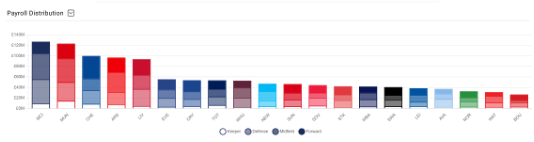
The best teams spend the most money on players. Or do they? Can a team with a lower budget succeed by being smarter than the rest? If it were only about money, then surely Manchester United would win the English Premier League every year, right? But they don’t —Leicester won it in 2016 despite having the 16th biggest budget out of 20 teams.
Challenging the financial status quo
As I write this, Arsenal sits top of the Premier League with the third biggest player budget for the 2025– 26 season. Brentford sit seventh with the smallest budget in the league this year. And underdog Brighton has consistently overperformed for many seasons.
Is this true across the football pyramid? Drop down to English football’s third tier, where I work as First Team Scout and Data/AI Lead for Reading FC. According to Capology, Stevenage is currently top with the 16th biggest wage bill out of 24 clubs. Lincoln is fourth with the 17th biggest wage budget.
Overall, there is a strong correlation between spending on wages and team performance. The Premier League has been dominated by Manchester City, Liverpool, Chelsea, and Arsenal for quite a few years. They are among the biggest spenders and can attract the top performers from around the world. Even the new EFL Championship League clubs, Birmingham and Wrexham, were promoted from League One with the biggest budgets at that level. Butit is possible to compete with less budget if you know how to build the right squad?
Using data to build better teams
So, what else drives success? My colleague, Sean Richardson, Player Recruitment Data Analyst at Reading FC, has been crunching the numbers recently to help our club decide how to structure the squad. We have new owners,and the financial restrictions as well as the transfer embargos have been lifted after a tough four years for the club.
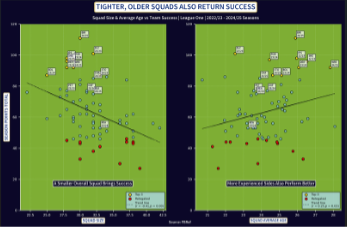
As you can see from Sean’s analysis, having a smaller squad and using fewer players leads to success on the field. Having older players also helps —more on that later.

As you might expect, =the key is having lots of different players who can score goals rather than being reliant on one super striker. It helps if you have a player who can net 20 times a season, but having other players contributing goals too is the key to promotion. A balanced team outperforms those who rely solely on spectacular talent.
This brings me to the biggest challenge of all: how do you win and balance the budget?
Navigating rules and regulations on spending
All English football teams have to abide by strict Profit and Sustainability Rules, and these differ from league to league. From August 2026, Premier League Clubs must abide by new Squad Cost Ratio rules, under which they can spend only 85% of their turnover on players and transfer fees.
How do you build a squad within the rules? Younger players grow in value and can be sold to other teams at a profit, but they don’t get you promoted in the short term. But if you can develop your own talent and sell them on, that reduces your wages in the short term because younger academy players get paid less, and the profits on selling those players allow you to invest in older, more established players who will get you promoted. So, you need a balance. That is why clubs like Brighton, Brentford, and Bournemouth have become established in the Premier League by finding and nurturing talent and knowing when to sell them at a profit. As long as your data analytics and scouting teams continue to discover that talent, the model can work. When it dries up, you can get relegated. Just look at what has happened to Leicester since they won the League.
Strategic timing in a competitive transfer market
There is one more challenge that hinders the smaller clubs: buying players is only allowed during two transfer windows per season, from July to September and in January. The January window is normally used for minor adjustments —replacing players who are out of form or injured. The summer window is the key to success when most players are bought and sold. But, while the window lasts for three months, for smaller clubs, the window action happens late every year. Clubs rush to finalize their squad close to and on deadline day. Why is that? Because the best players don’t want to sign for small clubs, and the bigger clubs don’t want to sell their spare players until the rest of the squad is purchased. Out-of-contract players are holding out to negotiate better wages and to see if better opportunities come their way.
Fans often say, “Why don’t we get our business done early? Why are there so few players ready to train at the start of pre-season on July 1?” It is because every smaller club has a dilemma. There are players available in July, but the best ones become available in late August and September. Coaches want their squads to work together pre-season, but they also want the best players who are waiting for a better offer. What would you do?
How clubs use data to identify talent
All clubs use data. All clubs have access to data. However, the over-performing clubs have more and use it better. There are free resources such as Transfermarkt, but the best tools cost money— like WyScout, Opta, SkillCorner, and Impect . Most of these sources provide event data:tackles, shots, headers, passes, etc. Some have advanced event data, like XG (expected goals) and XA (expected assists). Some have physical data, like sprints or meters run, and now some even have off-the-ball data. Impect call this “Packing data.”
There are 20 outfield players, so a player will only have the ball or challenge for it for about 5% of the match. Event data tracks this. This Packing data tracks the player for the other 95%. What do they do when they don’t have the ball? Do they create space for others to succeed? Do they cover defensive positions that stop the ball going to the player they are marking?
All of this data needs to be collected and analyzed in a way that is relevant to how your coach wants to play. This data can be used to identify strengths and weaknesses in your own players, but also to identify players in other teams that will do what you need to improve your team.
In the bigger clubs, scouting is data-driven. The analysts create lists of target players who are then watched live by scouts at games. Traditionally, it might have worked the other way around. A scout would identify a player at a match, and then the data analysts would see what they can find out about that player. This is inefficient and too reliant on that player happening to have a good game when the scout is at the match. Not everyone performs consistently every game. However, live scouting still has huge value. The data may tell you about the physical and technical information, but it won’t tell you why things are happening. Is their coach encouraging them to play a certain way? How are they tactically? How are they mentally? How do they react to a mistake? How do they interact with their teammates? Are they calm and composed? Can they adapt to the changing tactical needs of a game?
A good scout will do their research pre-match. Who are they there to watch? What does the data tell you about their previous performances? Which other players in the game could potentially be of interest? A good scout reports on what they see, not what they expect to see. A striker may have the highest shot conversion rate in the league, but on a given day, they may miss four easy chances. That is what the scout should report —those misses as well as any goals scored. A player will be watched many times, so one exceptional or bad day won’t cloud the overall picture. However, a habit of blowing the easy ones is too important to miss and, too often, easy to overlook.
Avoiding bias
Scouts must avoid being driven by their preconceptions. “Say what you see” is a good mantra. But football recruitment already has bias baked in. Only 27% of elite footballers are left-footed. . But only 12% of the actual population are left-footed. So, if you are left-footed, you actually stand a better chance of being picked up.
Studies on relative age effect (RAE) show that children born in the first quarter of a school year are significantly more likely to become professional footballers than those born in the last quarter. It is thought that the ratio is as large as 8:1 in English Category One Academies. At my club, Reading, we have a strong emphasis on this for scouts of younger-age players, but the ratio is still around 5:1.
What can business leaders learn from football?
Next time you wonder why your club doesn’t have a full squad of experienced players ready to win the League this season, have a think. What are the challenges of building a successful squad? How do you balance short-term and long-term success? How do you stay within the financial rules, but still outperform the bigger clubs?
The same applies to organizational leaders. What are the challenges of building a successful team? How do you balance short-term and long-term success in staffing? How do you stay within your budget, but still outperform the competition and—perhaps even better—the expectations?
The lesson for managers and leaders in business is around talent development, selection, and avoiding confirmation biases. Just as football clubs must have a strategy for succession and development plans in their systems, leaders in all organizations should be thinking, “Who’s the next player up, and will they fit in our system?” Be wary of pursuing solely “star” talent, and don’t skip over what might be uncomfortable blemishes on a record. Pay attention to skills, tactics, and their mental game as well.
Leaders would benefit from being good scouts of talent, and preparing, developing, and nurturing a robust pipeline of potential talent inside and outside of the organization. Having a strict, well-defined set of success and team-fit criteria will help leaders avoid bias in staff selection and ranking and increase the likelihood of finding undervalued talent to play a winning game.
About the author
Nick Baggott is a professor at Hult International Business School who has driven marketing strategy in over 50 countries. He co-founded Chemistry – which grew to become the UK’s largest independent agency – and has led digital initiatives for Microsoft and Google. He has consulted for brands like Lego and Vodafone, and today also serves as a First Team Scout and data/AI lead for Reading FC.