Is a Business Degree All Spreadsheets? We Sat In on Two Classes to Find Out

Say “business degree,” and most people picture spreadsheets, balance sheets, and an economics lecture that runs ten minutes over.
Some of that’s true. Most of it isn’t. At Hult, undergraduates learn business by doing it. They work on live briefs from real companies, with real deadlines, and pitch their ideas back to the people who set the brief.
We sat in two of Professor Lindsay Butcher’s classes to see what that looks like. Spoiler alert: neither one involved a balance sheet.
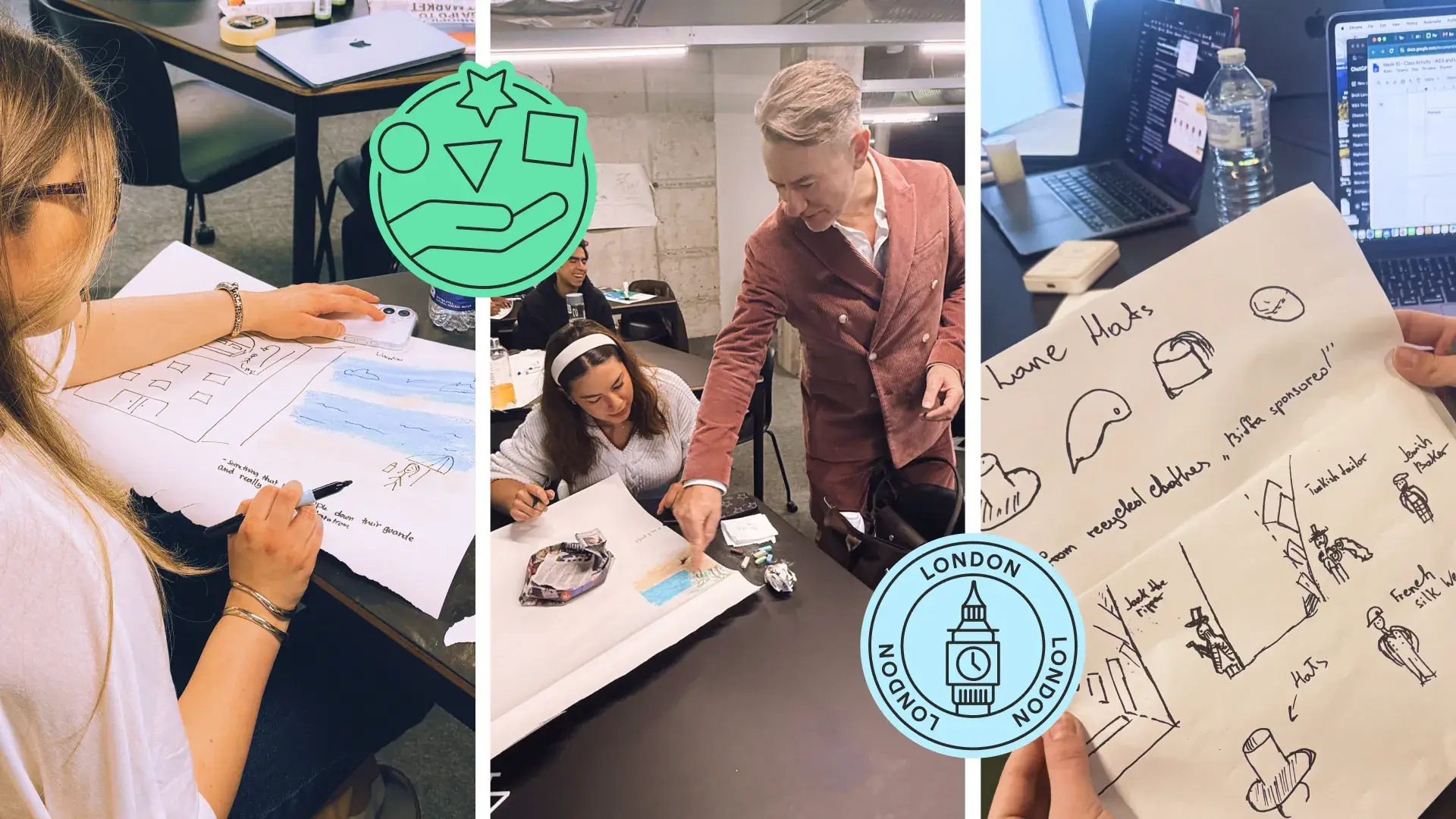
The first class is in the middle of a live project for Biffa, one of the UK’s biggest waste management companies. The brief is to raise awareness of waste collection on Brick Lane.
If you don’t know it, Brick Lane is one of London’s most famous streets. It’s packed with markets, street food, street art, and history, and that means a lot of waste.
Before anyone pitched, the class heard from the guest speaker, Omni Stephenson. He’s an illustrator and children’s book author who works to client briefs for a living. He walked students through his process: how he takes a brief and turns it into work a client signs off on.
It’s the same job the students were about to do for Biffa. Then each team developed an idea to pitch to Biffa, and nobody played it safe.
Maria is a final-year Bachelor of Business Administration (BBA) student from Yemen who’s aiming for a career in marketing and photography.
“We all throw out food all the time. My project is about raising awareness of food waste, using local amenities, and creating an opportunity to give back.”
Maria, final-year Hult BBA student
Her idea starts with food waste collection points at a busy Aldi. The food then goes to a row of pop-up stalls, where chefs turn it into dishes for people to taste and buy at the market. People get to try something new, eat food that would otherwise go to the trash, and maybe look at their own fridge a bit differently.
You know that moment when the bananas are about to turn? Hello, banana bread. Maria is doing the same thing on the scale of a London street market.
A team of six (Olta, Nazil, Carolin, Lyn, Oynou, and Adar) went after clothing waste. They want people to upcycle, recycle, or buy secondhand, and to think twice before hitting “next-day delivery.”
Their plan is to wrap a person in a giant receipt made of clothes and dress the buildings on Brick Lane in recycled clothing. The receipt lists what clothing waste really costs. For example, a garbage truck’s worth of textiles is sent to a landfill or burned every second, according to the Ellen MacArthur Foundation.
That’s hard to walk past, and that’s exactly the point.
The second class, Mindful Design, starts with students putting their phones in their bags and closing their laptops. Out come pens, newspaper clippings, watercolors, and chalk. Students get one question: where do you feel most at peace?
There’s a reason for it. The class is working with Beluga Pods, a UK startup whose app uses daily check-ins and small actions to get people off their screens and into in-person meetups, coffee gatherings, and community events. Beluga Pods asked Hult students how to create more meaningful, engaging spaces for people to connect.
Before you can design a space where people want to connect, you need to know what makes a space feel good. The fastest way to find out is to start with your own.
The responses were personal. Some students drew childhood bedrooms shared with siblings, with snow outside and a fire going. Others went straight to the beach. Professor Butcher drew a bird’s nest. Each student then turned that feeling into an idea they could pitch to Beluga Pods.
Everything. In both classes, students did what good businesses do:
Understand a real problem
Find a human truth people recognize
Turn it into an idea
Pitch it to an actual client
Sometimes the truth came from the waste on Brick Lane. Sometimes it came from a sketch of a snowy bedroom. Either way, creative thinking was part of the business process. It wasn’t decoration added at the end.
That’s why a business degree can lead to careers beyond finance. Maria is pursuing a career in marketing and photography. Even the guest speaker was a children’s book illustrator, and his work is shaped by client briefs, just like a brand team’s. Understanding people is a commercial skill, and you won’t find it in a spreadsheet.
Hult’s undergraduate degrees are built around live challenges with real companies from your first term. You learn from faculty who’ve done the job, alongside classmates from 140+ nationalities, at Hult’s campuses in Boston, London, and Dubai.
So, is a business degree all spreadsheets? Some of it, sure. Someone has to work out what the banana bread costs.